Matt Rubendall
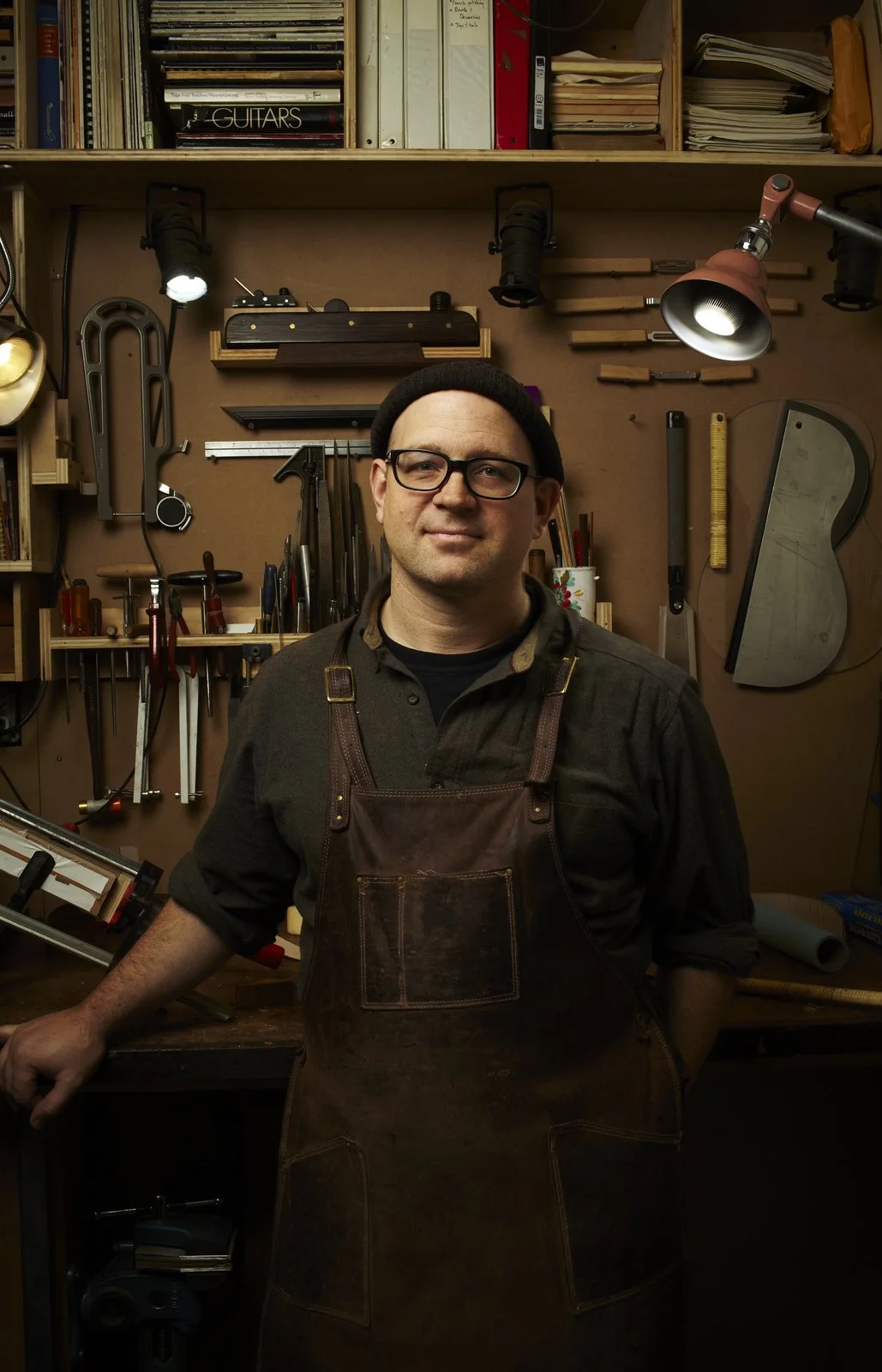
The overall sound quality I’m looking to achieve is based on balance. I want to have a piano like openness with a consistent note quality between each string. I’m more concerned with the musicality of the notes rather than building merely for loudness for its own sake. Using these tools, along with a personalized approach to wood choices and playing style, I can achieve a wide tonal palette while maintaining my own sound.
www.mattrubendall.com
matt@mattrubendall.com
917-575-0268
@mattrubendall
2026 Luthiers
I have been building and repairing guitars for nearly twenty years, always striving toward the ideal of craftsmanship. After many successes—and some failures—I continue to work to make each guitar better than the last, not only for the musician who will play it but also for myself, always looking to meet a higher standard.
Though my approach combines modern and traditional elements of guitar construction, I rely on hand tools and traditional methods whenever possible, even when it lengthens the process. My standard model loosely recalls the body style of a Herman Hauser I. I use elevated fretboards for playing comfort and stability, and compensated nuts and saddles to keep my instruments playing perfectly in tune. I handcraft the rosettes and decorative details that are unique to each guitar, and finish every instrument with the French polish technique.
Garrett Lee
Garrett Lee has enjoyed playing guitar since the age of nine. In 1999, his fascination and curiosity with guitar design, coupled with his love for woodcraft, drew him to begin building classical guitars. Trained as a research scientist with a Ph.D. in biochemistry, he enjoyed a career in academic research and later, in biotechnology. In 2006, he was compelled by the challenge and intrigue of lutherie to transition to building guitars full-time.
Gary's research background inspires creativity, thoughtful design, and exacting execution. His handcrafted classical guitars incorporate traditional and contemporary design, including double top soundboards and adjustable-action necks. Midway through his development, Gary received mentorship from celebrated American luthier John Gilbert.
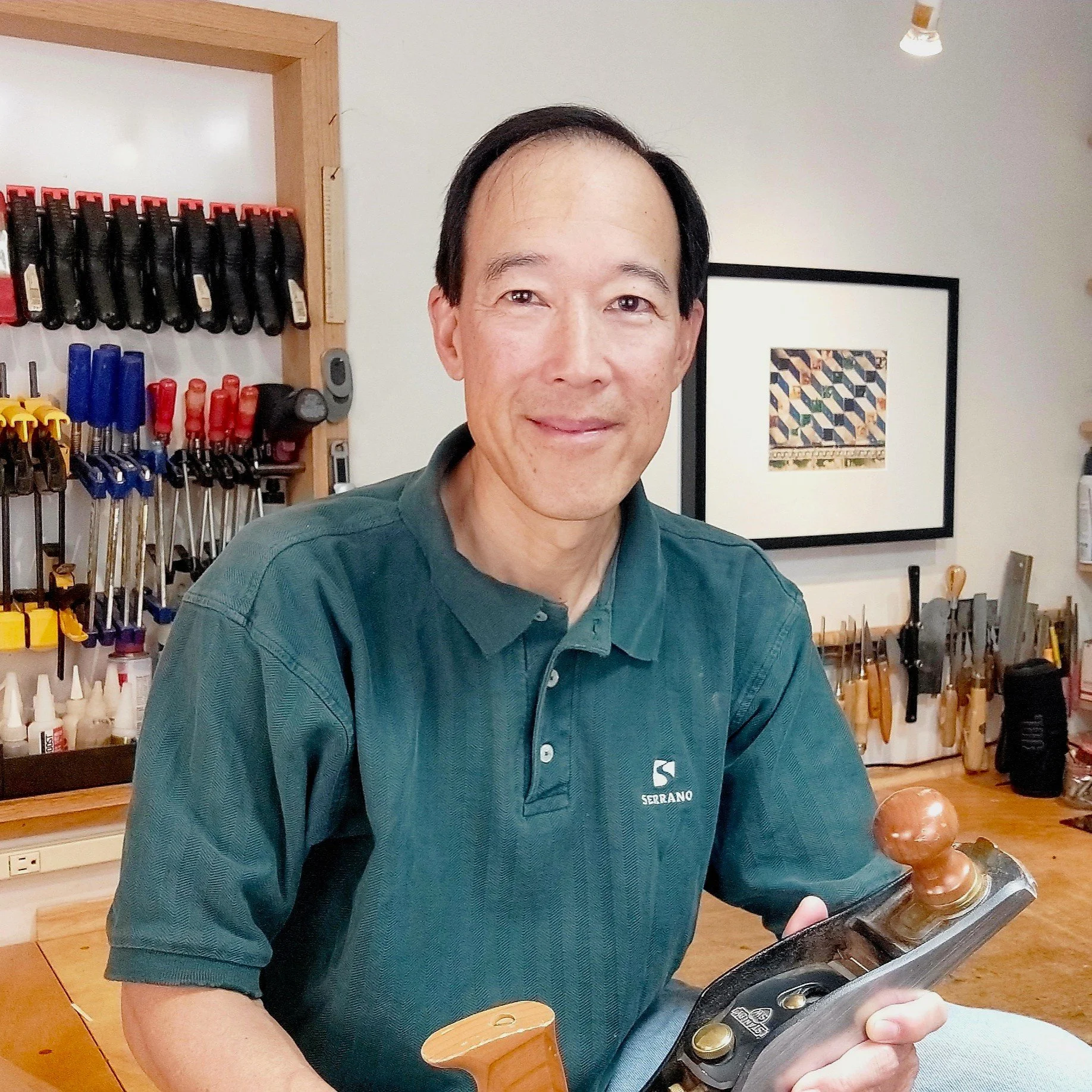
When he’s not building guitars, Gary enjoys playing them and lectures on lutherie for guitar societies, festivals, universities and music schools. He is the creator and host of Lutherie Demystified, a YouTube video series that explores the world of guitar building, acoustics and the lutherie profession in a way that can be enjoyed and understood by luthiers and players alike. As a member of the guitar community, Gary serves on the Board of Directors for the New York City Classical Guitar Society. He and his wife Candace live in Wayne, New Jersey, a suburb of New York City.
www.garrettleeguitars.com
gary@garrettleeguitars.com
862-226-8231
Lubos Naprstek
Born in 1964 in the Czech Republic, Lubos Naprstek was fascinated by crafting things of wood even as a small boy. His birthplace served only to nurture his inborn talents—the city of Kladno has a centuries old tradition of fine musical instruments. By the time he turned 17 he was already competent in the repair and complete restoration of musical instruments. He built his first guitar because he could not afford to buy a new one.
Today Naprstek has fully matured into a master luthier with an international reputation. His workshop just outside of New York City is called upon by collectors worldwide to repair and restore instruments built by Hauser, Simplicio, Fleta, and others. And his own instruments reflect a lifetime of studying the great instruments of the past while incorporating his own innovative refinements. His new doubletop is just such a blending of old and new. The sound of this instrument must be heard to be believed.
www.lubosnaprstek.com
lnaprs@gmail.com
917-204-4189
@lubosnaprstek
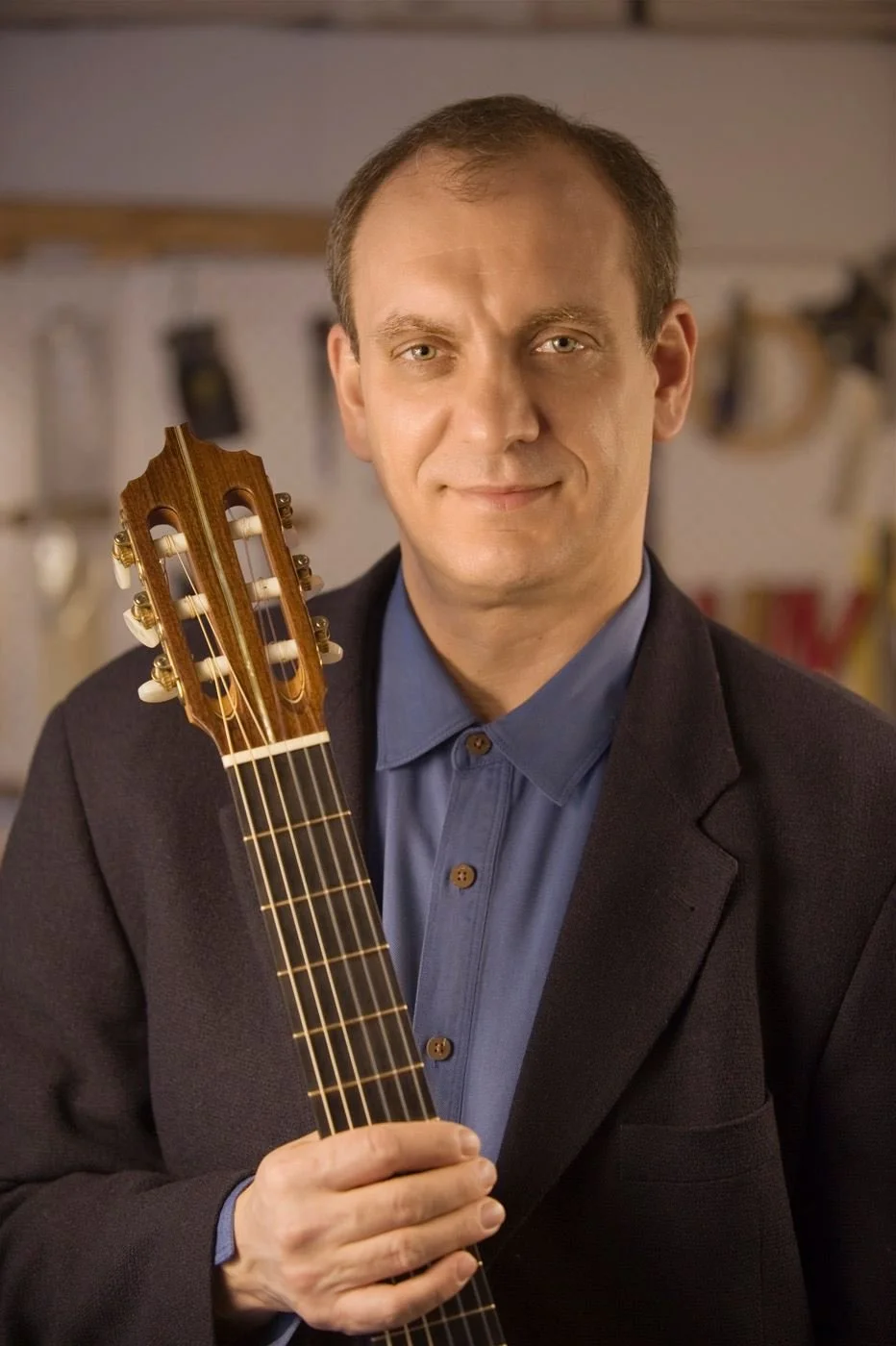
Brian Itzkin
Brian began his adventure in lutherie as a young teenager in Long Island, New York. Starting guitar lessons at the age of eight and inspired by his father’s woodshop, he crafted his first acoustic guitar from a C.F. Martin & Co. kit at only 13.
A year later, Brian started exchanging letters with luthier Ervin Somogyi. After two years of college, where he momentarily pursued an English degree, he studied under Stephen Hill in Granada, Spain. This experience ignited his passion for the classical guitar.
In Granada, during Spain’s COVID lockdown, Brian says, “I constructed several guitars, one of which I sold through Siccas Guitars, a renowned dealer in Germany. I gained credibility, secured numerous orders, and have been building guitars full- time for around two years now.” At 26 Brian
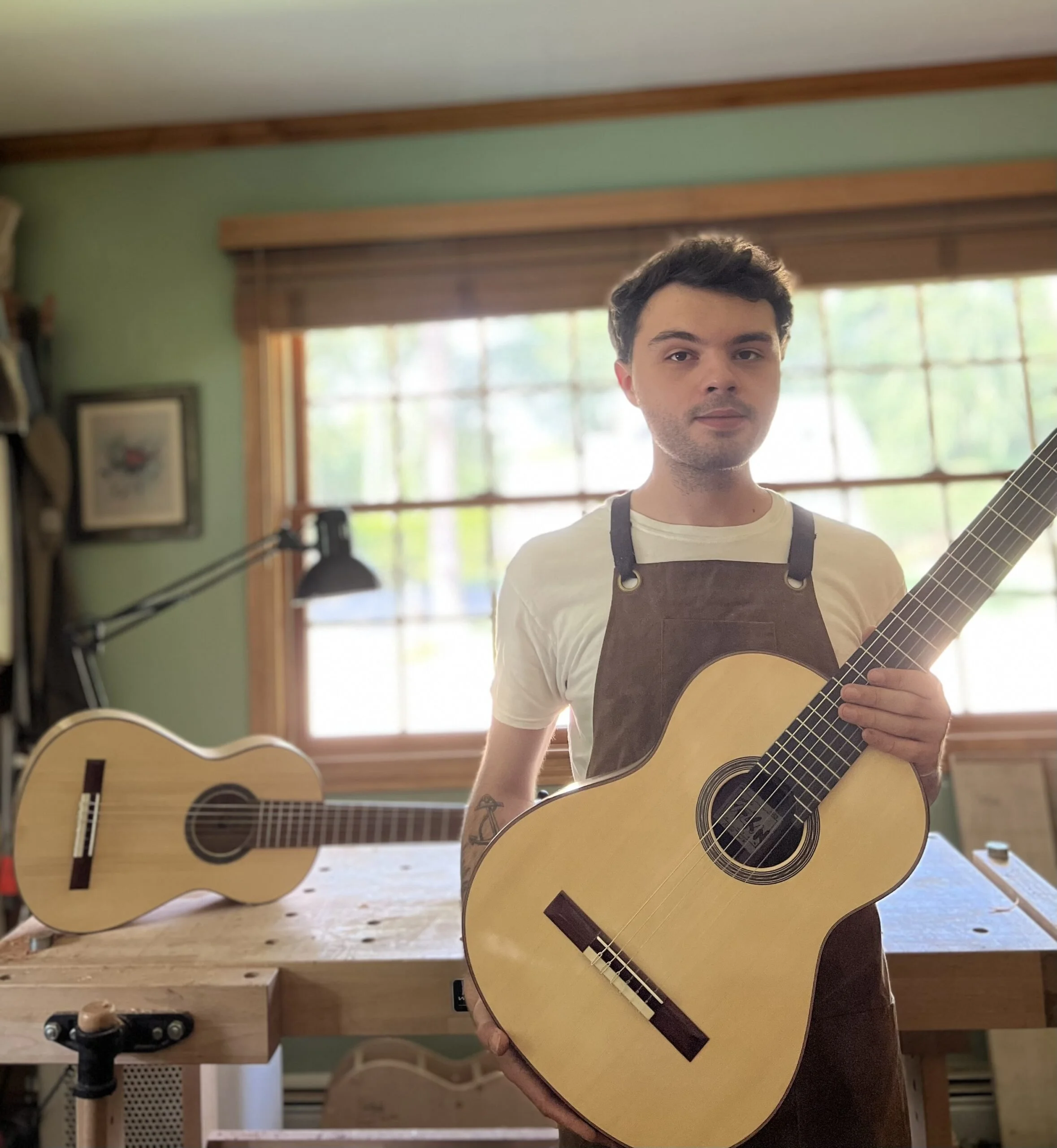
had been profoundly influenced by Spanish maker Antonio de Torres and Vicente Arias. He explains his approach by saying, “I tend to blend a 19th-century aesthetic with a modern tonal range. I desire my guitars to present a unified appearance where each detail complements the whole, and I believe they sound quite good, as well.”
Brian’s work is rooted in traditional techniques but isn’t limited to them. He has been designing a double-top guitar, incorporating cutting-edge materials like Italian Alpine spruce and aerospace-grade composite honeycomb. Brian prioritizes ethically sourced and recycled woods, like repurposed furniture. “I don’t want to be part of the darker aspects of the timber trade in the guitar-making world,” he says. “Alternative materials also tend to be more affordable, which benefits the client.”
brianitzkinguitars@gmail.com
@itzkin_guitars
Andy Danser
Andy Danser built his first guitar in the summer of 2001 under the tutelage of Canadian luthier Sergei de Jonge while attending a six-week course at the de Jonge workshop in Oshawa, Canada. This was a transformative experience for Andy and seeking a deeper understanding of traditional Spanish guitar making, he enrolled the following year in a course designed and taught by classical guitar scholar Roy Courtnall Summerfield at Newark and Sherwood College in Newark, Nottinghamshire.
While in the UK, Andy had the privilege of studying with esteemed luthiers Tony Johnson, James Lister, and Malachi Brady through the International School of Instrument Making’s guitar program. He also studied with Gary Southwell at his Nottingham workshop during a summer course.
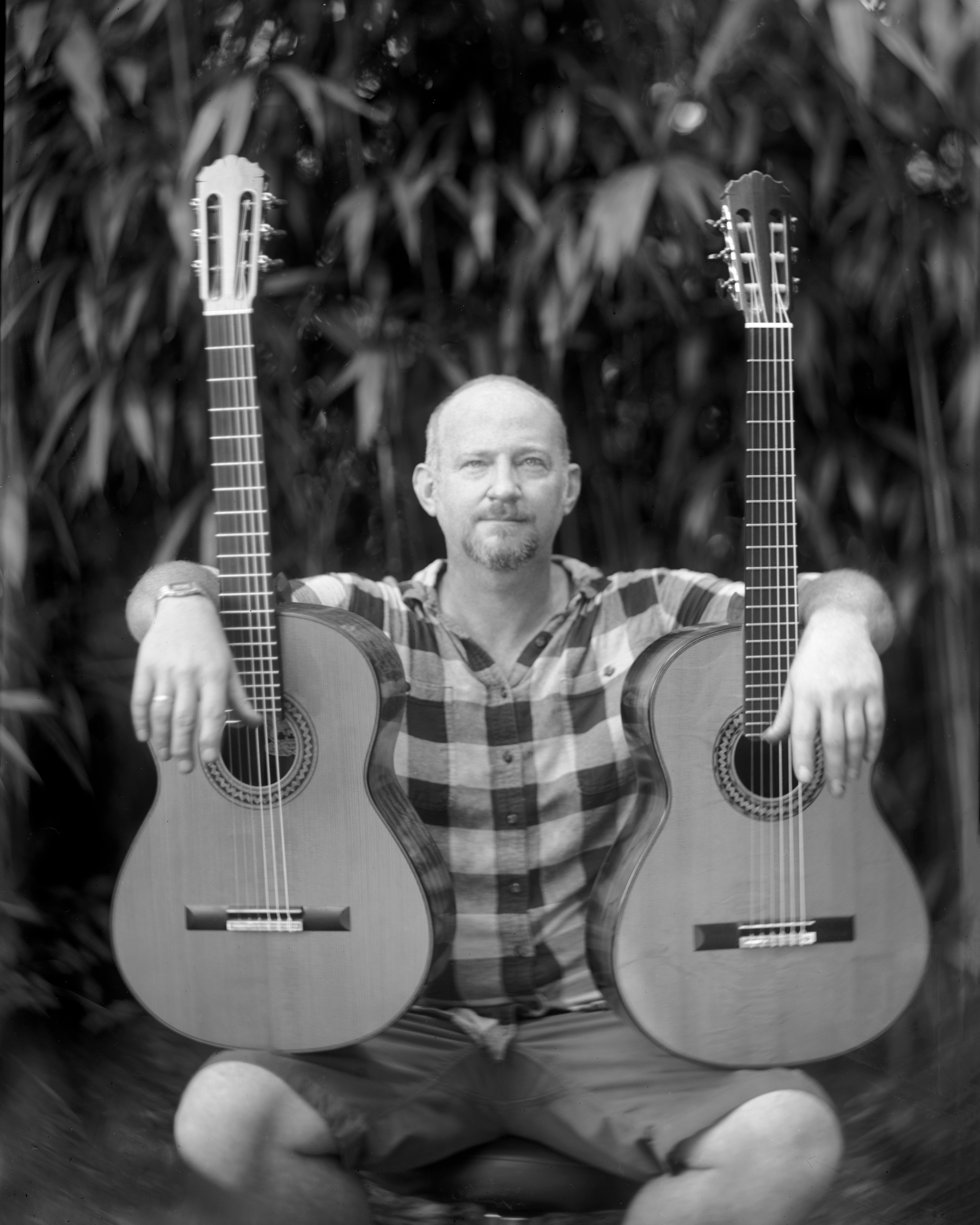
After returning to the United States, Andy moved to Brooklyn, New York, where he completed a two-year apprenticeship in guitar repair and restoration under Robert M. Jones, known as “Dr. Frets.” During his second month in the shop, Andy was tasked with restoring a 1951 guitar by French maker Robert Bouchet. This instrument was a true masterpiece of guitar making and galvanized Andy’s desire to be a professional luthier.
In 2006, Andy returned to his hometown of Durham, North Carolina, and founded Danser Guitar Works. In the early years of his career, he focused extensively on repairing, trading, and selling Spanish guitars. Through the rare opportunity to own and study instruments by master builders—including Francisco Simplicio, Enrique Garcia, Marcelo Barbero, Miguel Rodriguez, José Ramirez, Manuel de la Chica, Hermann Hauser Sr., Christian Aubin, John Gilbert, Robert Ruck, and Thomas Humphrey—Andy developed a deep understanding of what defines a truly exceptional guitar. These instruments continue to inspire awe and inform his work enormously.
At the beginning of the pandemic, after nearly 20 years of building several guitars annually alongside repair and restoration work, Andy made the decision to focus on guitar building full time. This shift gave him the time and mental latitude to explore modern, ultralight, composite-top guitar construction and design. While his foundation remains rooted in the traditional Spanish guitar, Andy now primarily builds balsa-core “double-top” guitars, aiming to preserve the tonal character of Spanish instruments while enhancing projection, power, headroom, and sustain for both contemporary and traditional repertoire on the concert stage.
Andy lives in Durham, North Carolina, with his wife, Shelley, and their children, Clara and Jack. His workshop is located in Old West Durham, near Duke University.
www.danserguitarworks.com
andy@danserguitarworks.com
919-286-3268
Matt Jacobs/Shadowfax Guitars
My philosophy when building classical guitars is to honor the tone of the great Spanish builders, Torres, etc... while adopting modern innovations.
What does that mean? The Spanish builders have a tone that has a welcoming warmth and a lyrical quality that grabs you, think Lagrima. However, those guitars typically don't meet the volume needs of modern players, as well as the amenities that modern classical (oxymoron, I know) guitarists are used to. So, I have developed building techniques that are able to bridge the gap.
Matthewrjacobs@hotmail.com
917-499-2112